What grammar is — not what it consists of
Grammar is the generation of thought.(def-1)
In other words, it is grammar that generates thoughts.
That sounds simple, but it says what grammar is, not what it consists of. What pass for definitions of grammar are really descriptions, not definitions.
Thoughts are mental, composite, simulated representations of occurrences.(def-2)
Grammar generates thoughts through six fundamental concepts: parts of speech, moods, diatheses, aspects, clauses and syntax. Everything else (morphology, vocabulary, punctuation, pronunciation and so on) is paragrammar.
These concepts are not new. Grammar as a discipline was founded by the Greeks: by Socrates (470–399 Before Year 1, BY1) in Plato's Cratylus, who examines the correctness of names and distinguishes nouns (ὀνόματα) from verbs (ῥήματα); by Dionysius Thrax (c. 170–90 BY1), whose Art of Grammar set out the eight parts of speech; and by Apollonius Dyscolus (2nd century After Year 1, AY1), who founded the study of syntax.
When we think of something, all six concepts are set in motion. No thought is possible without all six.
The human brain is wired to generate thought in exactly the same way, regardless of language. Grammar is therefore a panhuman trait that unites us all in a very special but overlooked way. Grammar is universal; language is not.
Communication is the exchange of messages that carry meaning.(def-3)
Every message that carries meaning carries thought, and no thought exists without grammar. All communication is therefore grammatical.
Language is often said to be what gives thoughts a voice, but that is a metaphor, not a definition.
Language is paragrammatical communication.(def-4)
In other words, language is communication via paragrammar. All communication is grammatical, but only language is both grammatical and paragrammatical. Grammar is what all languages share with all thought; paragrammar is how each language dresses it.
Take one simple sentence: We bought fish this morning. Say it in Danish, Greek, Spanish or any other language, and the words change, the endings change, the word order may change. But the grammar does not.
Parts of speech
We is a pronoun, bought is a verb, fish is a noun, this is an adjective and morning is a noun.
Many words can belong to different parts of speech in different contexts, but in a given context each word belongs to only one. Taken one by one, their equivalents belong to the same parts of speech in every language.
In Greek or Spanish, we can be stated (εμείς, nosotros/as) or left to the verb ending. Either way, the pronoun is there. Only its marking differs, and that is paragrammar.
Mood
The sentence states a fact. It is in the indicative mood, in all languages.
Diathesis
The subject performs the action: we did the buying. The sentence is active, in all languages.
Aspect
The buying is seen as one complete act. The aspect is synoptic, in all languages.
Clause
It is a declarative main clause, in all languages.
Syntax
We is the subject, bought is the verb, fish is the direct object and this morning is the adverb, in all languages.
Six concepts, and not one of them changes across languages. What varies from language to language is how each language marks them: its endings, its word order, its spelling, its pronunciation and so on. That is paragrammar.
Thought comes first
Before anything is said or written, it exists as a thought. We do not first find the words and then work out what they mean. We think first, and then we look for the words. The thought is already complete in the mind, with all six concepts in place, before any language gives it form.
Language comes after. It chooses the words, the endings and the word order, and decides how much of the thought is said aloud. By then, grammar has already done its work. Grammar generates the thought; language communicates it. The next two examples show this.
A second example
Take another sentence: The children were playing in the garden.
Parts of speech: the article, children noun, were verb, playing participle, in preposition, the article, garden noun.
Mood: indicative.
Diathesis: active.
Aspect: progressive. The playing is seen as ongoing, not as one complete act.
Clause: declarative main clause.
Syntax: the children subject, were playing verb, in the garden adverb.
Compared with the first sentence, only the aspect differs. One concept changes, and the thought changes with it: a completed purchase becomes an ongoing game.
What is not said
Someone asks: When are you leaving? You answer with one word: Tomorrow.
One word is spoken, yet the listener understands a complete thought: [I am leaving] tomorrow. The words in brackets are not said. They are implied, and grammar supplies them.
Parts of speech: [I] pronoun, [am] verb, [leaving] participle, tomorrow adverb.
Mood: indicative.
Diathesis: active.
Aspect: progressive.
Clause: declarative main clause.
Syntax: [I] subject, [am leaving] verb, tomorrow adverb.
All six concepts are at work, although only one word was spoken. That is what it means for grammar to generate thought: the thought is complete before a single word is chosen. How much of it we say aloud is paragrammar.
The parts of speech
Before we list the parts of speech, let us define them.
The parts of speech are non-semiotic categories of interacting concepts that clarify the semantics of speech.(def-5)
Non-semiotic means that the parts of speech have no morphology; that is, we do not take morphology into account when dealing with the parts of speech. Semantics means meaning.
It follows that the definition of each part of speech must be honoured strictly and without exception.
The part of speech to which a word belongs in a given sentence is determined solely by the definition whose criteria that word actually satisfies.
Each part of speech has a specific definition. The criteria of the definitions are exclusively semantic, never morphological.
There are ten parts of speech, the same in every language. Some languages, such as Polish and Chinese, have no articles, so they have nine.
1. Nouns
2. Articles
3. Pronouns
4. Adjectives
5. Verbs
6. Participles
7. Adverbs
8. Prepositions
9. Conjunctions
10. Interjections
Nouns are words that name entities.(def-6)
An entity is anything we can name: a person, a thing, a place, an idea. Fish, Copenhagen, teacher and justice are all nouns, because each one names an entity.
The definition decides, not the form. In Swimming is healthy, the word swimming ends like a verb form, but here it names an activity as an entity. It satisfies the definition of a noun, so it is a noun.
Articles are the words that determine the selectivity of nouns.(def-7)
Compare I bought a fish with I bought the fish. With a, the fish is not selected: it is any one fish. With the, the fish is selected: it is a particular fish that speaker and listener both know. The noun is the same; the article determines how selective it is.
Pronouns are words used in place of nouns.(def-8)
In Maria bought a fish. She cooked it., the word she stands in place of Maria, and it stands in place of fish. In our first sentence, we stands in place of the names of the people who bought the fish.
Adjectives are words or groups of words that qualify nouns.(def-9)
In fresh fish, the word fresh qualifies the noun fish, so it is an adjective. In our first sentence, this qualifies morning, so it is an adjective too.
An adjective can also be a group of words. In fish from the market, the group from the market qualifies fish. By the definition, it is an adjective.
Verbs are words that take a subject.(def-10)
Subjects instantiate the meaning of verbs.(def-11)
On its own, bought is only a meaning: an act of buying, by no one in particular. In We bought fish, the subject we instantiates that meaning: the buying becomes an act that someone actually performed.
Participles are derivatives of verbs that introduce retrievable elliptical clauses.(def-12)
A participle stands for a whole clause that has been shortened. The clause can always be retrieved:
Having injured his knee, he limped home. = Because he had injured his knee, he limped home.
Once mentioned, the name went viral. = After the name was mentioned, it went viral.
In each case, the elliptical clause has been retrieved, and the meaning is unchanged.
Adverbs are words or groups of words that qualify verbs, adjectives, other adverbs and also clauses, with respect to time, place, manner, frequency, degree, attitude or perception.(def-13)
Adverbs answer the questions where?, how?, when? and how much? The last one can be extended: how often? how high? how surely? how much better? An adverb can even be an answer on its own.
1. Maria sings beautifully. The adverb beautifully qualifies the verb sings. How does Maria sing? Beautifully! It is an adverb of manner.
2. Some people are incredibly naive. The adverb incredibly qualifies the adjective naive. It is an adverb of degree: it tells us how naive.
3. We go swimming very early. The adverb very qualifies the adverb early. Very is an adverb of degree; early is an adverb of time.
4. Perhaps they don't believe you. The adverb perhaps qualifies the whole clause they don't believe you. It expresses probability.
Prepositions are words or groups of words that take nouns or noun phrases as objects and express place, time, direction, cause, manner and so on.(def-14)
There is no preposition without an object.
1. I gave the books to them. The preposition to takes the object them, a pronoun standing in place of a noun, and expresses direction.
2. The keys are in my pocket. The preposition in takes the noun phrase my pocket and expresses place.
3. I studied the problem in depth. The preposition in takes the noun depth and expresses manner.
Noun phrases are phrases that contain nouns or pronouns and can function as subjects, objects or complements.(def-15)
1. drama → noun; a lot of drama → noun phrase. If a film has a lot of drama, it is usually tiring. A lot of drama is the direct object of the verb has.
2. story → noun; a long story → noun phrase. Her life is a long story. A long story is the complement of the verb is.
3. moments → noun; the hard moments → noun phrase. The hard moments forge character. The hard moments is the subject of the verb forge.
Conjunctions are words or groups of words that establish a relation of subordination, that is, of interdependence, between clauses.(def-16)
All conjunctions are hypotactic. The notion that some conjunctions are paratactic is unfounded and will be dealt with in due time.
Conventional grammar books divide conjunctions into two categories: coordinating and subordinating. But why is this division made, and what does it contribute to the understanding of grammar?
Conjunctions are divided in this way because the so-called grammarians have not grasped that, with the exception of conditional clauses, if we remove the conjunction from any subordinate clause, it automatically becomes a main clause. This happens not only with the "coordinating" conjunctions, but with all conjunctions.
1. I stayed at home because it was raining. Without because: It was raining. A main clause.
2. I stayed at home, but she went out. Without but: She went out. A main clause.
As a rule, what makes a clause subordinate is the presence of a conjunction. The story does not end there, however. As we will see, even clauses without any conjunction are sometimes subordinate, because the semantics itself requires it.
The nominal authors of grammar books simply copy other grammar books and paste the copy into a "new" book, changing only a few superficial details to keep up appearances. It goes without saying that the only thing this division of conjunctions contributes to grammar is abundant and pervasive confusion.
It is also very important to point out that the definitions of concepts in these books, when they are given at all, do not meet the requirements of horistics. Beyond that, the "authors" of these books repeatedly violate the very definitions they supposedly formulated. The truth is that they simply copy from other books whatever definition happens to catch their eye.
Interjections are words or groups of words that express emotion and have no syntactic role.(def-17)
By emotion we also mean will (shh! meaning silence, come on!), hesitation (hm, er) and social convention (hello, thank you), when these words are used as exclamations.
1. Phew, it's finally over! The word phew has no syntactic role: it is not a subject, a complement, an object or anything else. This holds for all interjections.
2. Ah, how I miss my mother!
3. Ouch, what happened to me!
4. Bravo, you did it perfectly!
A handful of words fit none of the definitions of the ten parts of speech. We call those words particles.
In the next edition: the moods, discussed in detail.
The Law vs The Penalty For Breaking The Law
Enforcing the penalty for breaking the law is not the law itself.
What is justice? Let us define it:
Justice is the prevention of crime.
Once a crime has been committed, no justice can be done, because justice is preventing crime. What follows — arrest, trial, imprisonment — has to do with the penalty for breaking the law, which is not justice. So what is called law enforcement is really penalty enforcement.
This shows a great deal about the revealing power of definitions, and what it reveals is central to a myriad of misconceptions that derail millions of lives.
Consider the phrase we hear on the news every week: the criminal was "brought to justice." He was not. He was brought to penalty. The justice that could have been done was the prevention of his crime, and that moment passed before the crime took place. What remains after the fact is a consequence, not a remedy.
Consider the victim. We tell the victim that justice will be done, that the verdict will bring justice. But the harm has already happened, and no sentence undoes it. The victim is promised one thing and given another. Many wait years for a trial expecting relief, and when the sentence comes, they feel strangely empty. They were not wrong to feel it. They were given the wrong word.
Justice is confused with punishment, with revenge, with financial compensation and with the legal. It is none of them. Punishment is the penalty imposed after the crime. Revenge is harm returned for harm. Compensation is money paid for damage already done. The legal is what the law permits or forbids, and it is not uncommon for the legal to be unjust and for the just to be illegal. Opioids were legally marketed and prescribed on a mass scale, and an epidemic of addiction followed. In many countries, people are penalized for speaking freely. All four come after the crime or stand beside it. Not one of them prevents it, and so not one of them is justice.
Consider the politician. When politicians promise to be tough on crime, they nearly always mean tough on penalty: longer sentences, more prisons, more police after the fact. Each of these acts only after a crime has been committed. By the definition, none of them is justice. A government that spends most of its effort on penalties is not a government that does justice. It is a government that manages the failure of justice.
If justice is the prevention of crime, then justice means eliminating the reasons that lead anyone to commit a crime, so that citizens have no reason to commit crimes in the first place. Every crime has a reason behind it, whether need, ignorance, exclusion or despair. Remove the reason, and the crime has nothing to grow from.
That is primarily the duty of politics, as politics is properly defined. Not the courts, which arrive too late. Not the police, who arrive after the call. Not the prisons, which hold the consequences of a failure that has already happened. Politics is the only institution placed before the crime, where the reasons for it are formed, and so it is the only one that can do justice at all.
One definition, stated precisely, moves justice from the courtroom to the classroom, from the prison to the home, from the end of the story to its beginning. That is the revealing power of definitions. A society that confuses penalty with justice will keep building prisons and wondering why crime does not go away. A society that defines justice correctly will ask a different question: not how to punish, but how to prevent.
The Use Of Nuclear Weapons Is No Longer Unthinkable
Theodor Herzl was the visionary of Greater Israel
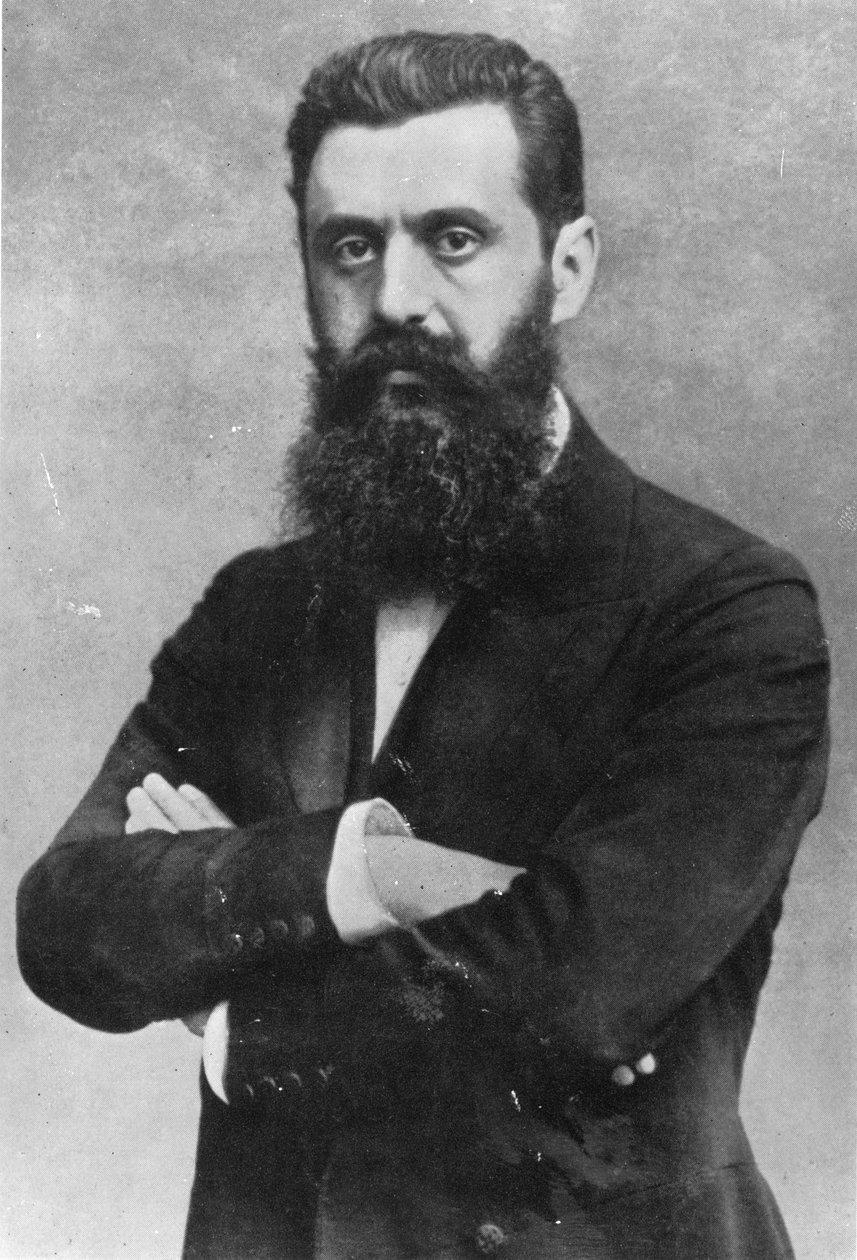
Theodor Herzl (1860–1904) was an Austro-Hungarian Jewish journalist, writer and political activist who became the central founder of modern political Zionism.
Born: Budapest, 2 May 1860
Died: Edlach, Austria, 3 July 1904 (buried in Vienna)
Profession: journalist, playwright, writer
Major work: Der Judenstaat (The Jewish State), 1896
Political role: organized the First Zionist Congress in Basel in 1897 and became president of the newly established Zionist Organization.
Objective: a publicly and legally secured homeland for the Jewish people.
He pursued international diplomatic support for this project, including negotiations with the Ottoman Empire and the British government.
Herzl died decades before the establishment of the State of Israel in 1948, so he did not take part in the creation of the state itself. His writings and political organization nevertheless became foundational to the Zionist movement.
To set the tone, let us go back to London in October 1902. On 23 October, according to his own diary, Herzl entered the office of Joseph Chamberlain, Britain's Colonial Secretary, at a quarter past twelve. He came with a request: territory under British control for Jewish colonization. He named three places: Cyprus, El-Arish and the Sinai Peninsula.
No transcript of the meeting exists. What survives is Herzl's own account, written in his diary the following day. It is the primary source, and it is revealing precisely because it is his.
Herzl explained why he could not simply wait for his negotiations with the Ottoman Sultan, who ruled Palestine. He compared them to buying a carpet: "If you want to buy a carpet, first you must drink half a dozen cups of coffee and smoke a hundred cigarettes; then you discuss family stories, and from time to time you speak again a few words about the carpet. Now I have time to negotiate, but my people has not. They are starving in the Pale. I must bring them immediate help."
Chamberlain replied that he could speak with authority only about Cyprus, because El-Arish and Sinai fell under the Foreign Office. On Cyprus, Herzl records his answer:
"Cyprus is inhabited by Greeks and Moslems. I could not crowd them out for the sake of new immigrants. On the contrary, it would be my duty to take their side."
Chamberlain then added that if Herzl could point to a place in Britain's possessions where there were no white inhabitants, he would be willing to discuss it.
Herzl did not let Cyprus go. He proposed creating a current in favour of Jewish settlement on the island, driven by Jewish capital. In his own words:
"Once we establish the Jewish Eastern Company, with 5 million pounds capital, for settling Sinai and El Arish, the Cypriots will begin to want that golden rain on their island, too. The Moslems will move away, the Greeks will gladly sell their lands at a good price and migrate to Athens or Crete."
And Herzl immediately records Chamberlain's reaction: "He seemed to take to the idea."
The sequence matters. Chamberlain refused to crowd out the Greeks and Muslims of Cyprus. Herzl answered with a plan by which they would leave on their own: the Muslims would move away, the Greeks would sell and emigrate. And by Herzl's account, Chamberlain seemed to take to it. This is not a later interpretation of Herzl's position. It is in his own diary, written during his London negotiations of October 1902.
The next day, Chamberlain arranged for Herzl to see the Foreign Secretary, Lord Lansdowne. But he told Herzl to leave Cyprus out of that meeting: "The part of the Plan relating to Cyprus is my business."
The Cyprus option closed there. Britain looked into El-Arish, but that plan failed over the Egyptian government's position and the lack of water. In 1903, Chamberlain offered something else entirely: territory in British East Africa, the so-called Uganda Scheme.
Many allege that the October 7, 2023 attack was allowed to happen so that the Netanyahu government could use it to justify the displacement of Palestinians from Gaza. This echoes an aspect of Theodor Herzl's thinking: when discussing Cyprus with Joseph Chamberlain in 1902, Herzl envisaged the departure of the Muslim population and the sale and migration of the Greek population to Athens or Crete.
Israel is now pursuing a policy aimed at changing the Iranian regime. Given Iran's size, population, geography, military capabilities and demonstrated resilience, however, it is far from certain that Iran would capitulate through conventional military operations alone. The conflict has already demonstrated Iran's capacity to absorb substantial military pressure while continuing to retaliate.
Yet neither Israel nor the United States can easily abandon the goal. Both have invested heavily in regime change, and giving it up would mean a serious loss of face and a heavy psychological blow to both.
Meanwhile, there are reports of increasing Israeli involvement with Cyprus, including Israeli investment and security cooperation. If the Israeli government eventually concludes that military pressure will not produce regime change in Iran, a dangerous question arises: would it escalate to the use of tactical nuclear weapons? Such a step would not necessarily guarantee the collapse of the Iranian state and could instead produce an uncontrollable escalation.
The consequences could extend far beyond the Middle East. A nuclear attack by Israel could create pressure for other nuclear powers, including Russia and China, to intervene or respond militarily. Whether they would actually use nuclear weapons cannot be predicted, but the possibility would make such an escalation a threat to the entire international community.
Donald Trump's threat at the UN General Assembly on 22 September 2026, when he asked whether he should "annihilate the Islamic Republic" if no peace deal is reached, demonstrates how extreme the current rhetoric has become. The possibility of further escalation therefore concerns not merely Israel, Iran or the Middle East, but potentially humanity as a whole.
Subscribe
Published monthly in English, Danish, Polish, Greek and Spanish. Available in print and as PDF.
Schools
1,995 kr. (€268) a year per school. Includes the PDF edition in every language, which the school may copy for its own pupils and teachers.
Businesses and organisations
1,495 kr. (€200) a year. Includes the PDF edition for up to 10 readers. Larger groups on request.
Individuals
Print: 799 kr. (€107) a year. PDF: 399 kr. (€54) a year. Single copy: 20 kr. (€2.70).
Grammar lessons
Individual and group lessons in grammar, in English, Greek and Spanish. Enquiries: mind@horistics.com.
Contact
To subscribe, write to mind@horistics.com with your name, address and the edition you want. Pay by MobilePay 27 13 44 83.